Quick answer
Put the dinner plate about 1 to 1½ inches from the table edge. Forks go on the left, the knife (blade toward the plate) and spoon go on the right, and utensils are set in the order you use them, from the outside in. The napkin goes to the left of the forks or on the plate, and the water glass sits at the tip of the knife. Keep the centerpiece low so guests can see each other, keep candles at least 12 inches from anything that burns, and don't leave food out for more than 2 hours (1 hour above 90°F).
You don't need a full formal setup to host a good Christmas dinner. What guests notice is a table that is tidy, has room to eat and doesn't get in the way of conversation. A note on sources: the placement rules come from Ohio State University Extension and Washington State University Extension, with details from North Dakota State University Extension and Lenox, a tableware maker. The candle rules come from the U.S. Fire Administration (USFA) and the Consumer Product Safety Commission (CPSC), and the food rules from the USDA Food Safety and Inspection Service (FSIS). Washington State's guide itself says there are "no hard and fast rules" and that customs change, so treat the layout as a starting point and adapt it to your table.
Step 1: Plan the space and the table cover
- Count the room per guest. Ohio State says to allow 20 to 24 inches for each place setting. Washington State says 24 to 30 inches if the table allows it. A setting includes the silverware, plates, glass and napkin for one person.
- Use only what the meal needs. Ohio State says to use only the flatware and plates that are necessary for the meal. Fewer pieces also means a tidier table.
- Center the tablecloth. Ohio State says the center fold should fall on the center line of the table, and the cloth should hang over no more than 10 to 12 inches. Placemats and a table runner are also fine. Washington State calls placemats an acceptable substitute for a tablecloth.
- Protect the table. Washington State suggests a silence cloth under a full-sized tablecloth to absorb sound and protect the top from stains and heat marks (not under lace), and hot pads under hot dishes if the tabletop will stain.
- Keep one element plain. Washington State's general guideline is to use one plain element on the table. If your holiday dishes have a pattern, a plain cloth lets them stand out; if the dishes are plain, the cloth or napkins can carry the color.
- Mark each seat with a plate first. Washington State says the simplest way to space settings is to mark each one with a plate. Set one plate, then space the rest evenly.
Step 2: Set one basic place
This is the setup for a casual one-course dinner. Every other course adds to it.
- Dinner plate: in the center of the setting. Ohio State puts the plate, flatware and placemat 1½ inches from the table edge for an attractive table and for safety. Washington State puts the plate edge and the silverware handles about 1 inch from the edge. Pick one distance and use it for every seat.
- Forks: to the left of the plate, tines up (Washington State).
- Knife: to the right of the plate, with the cutting edge toward the plate. Lenox says the same, "blades turned toward the dinner plate."
- Spoon: next to the knife, bowl up (Washington State).
- Napkin: to the left of the forks, folded in a square or rectangle with the open edge toward the plate (Ohio State and Washington State). Washington State also allows the napkin to sit on the plate.
- Water glass: at the tip of the knife. If a second drink is served, Washington State puts that glass to the right of the water glass and slightly forward.
Line the silverware up parallel, with the handles even, so each setting looks tidy. If the meal needs no knife, Washington State says the fork can go on either the right or the left.
Step 3: Add the extras for more courses
- Order of use. Ohio State says flatware goes in order of use from the outside in. NDSU Extension says the same: use the utensils farthest from the plate first and work toward it.
- Salad fork and soup spoon. NDSU puts the salad fork to the left of the dinner fork and the soup spoon to the right of the dinner spoon.
- Bread plate. Washington State places a bread and butter plate just above the dinner fork, with the butter knife on it, cutting edge toward the center of the plate.
- Salad plate. Washington State says to put an individual salad plate to the left of the forks and napkin. If the setting gets crowded, skip the bread plate and put the salad plate above the dinner fork, or serve bread on the dinner plate.
- Dessert utensils. NDSU places the dessert spoon above the dinner plate. Lenox says you can also bring the dessert utensils out with dessert.
- Hot drinks. Washington State puts the cup and saucer to the right of the spoons, or in the center of the setting if the drink is served after dinner.
- Charger. For a formal table, Lenox puts a charger under the dinner plate and removes it when the entrée arrives. It also says to set no more than three of any utensil and to bring out a fourth utensil with its course.
Step 4: Make the table look like Christmas
The sources give the rules for the layout, not for the theme, so this part is a matter of taste. These guidelines will keep it from getting in the way:
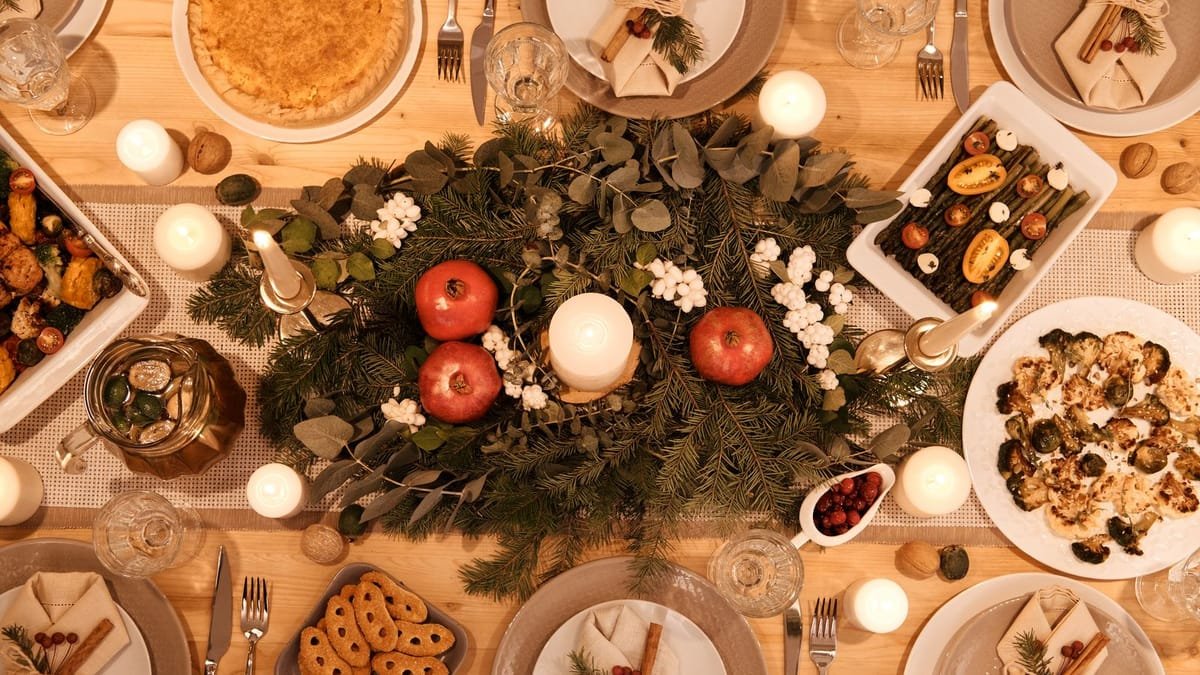
- Keep the centerpiece low. Ohio State, Washington State and Lenox all say to keep it low so people can see each other across the table. Ohio State adds that it should be in scale with the table and can be part of the meal, such as a fruit bowl.
- Stay restrained. Washington State says restraint and harmony matter most, that table decorations should complement the setting and the food, and that an overdecorated table is undesirable. It lists flowers, fruits and candles as the most common decorations.
- Greenery is a simple choice. Lenox lists fresh flowers and greenery as a tasteful option, and says formal arrangements are usually symmetrical. A few sprigs of evergreen on a runner or on each plate is an easy way to add Christmas without adding height.
- Choose a cloth color that works with the dishes. Lenox says to pick a tablecloth color that complements the other pieces; white linen is the most formal but not required.
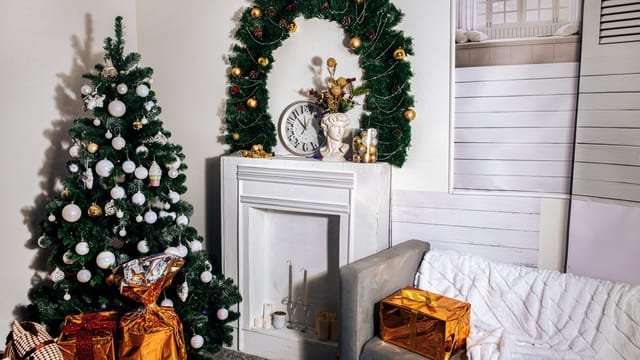
If you want a tree that matches, see our guide to decorating a Christmas tree step by step.
Step 5: Use candles safely
- Mind the distance. The USFA says to keep candles at least 12 inches away from anything that burns, or to consider flameless candles. On a Christmas table, that means greenery, paper napkins, ribbon and place cards.
- Keep them in sight. The CPSC says to keep burning candles within sight and to put them out before you go to bed, leave the room or leave the house.
- Mind the height. Washington State says candles should stand above or below eye level so the light isn't annoying, and to use enough candles to give adequate light for dining.
Step 6: Plan how the food gets to the table
Family style. Washington State says to put the food in serving dishes with a serving spoon or fork beside each one, and to place the dishes where they are easy to pass. It calls passing everything to the right common practice, with each dish returned to its place. It also suggests a side table or cart for extra drinks and breads.
Buffet. If you have more people than the table seats comfortably, Washington State suggests serving from a buffet and seating guests at small tables or giving them lap trays.
Keep the food safe while it sits out. FSIS says bacteria grow fastest between 40°F and 140°F and can double in as little as 20 minutes. Its rules for the table:
- Never leave food out of refrigeration for more than 2 hours. If it is above 90°F, the limit is 1 hour.
- Keep hot food at 140°F or above, using chafing dishes, preheated steam tables, warming trays or slow cookers.
- Keep cold food at 40°F or below by placing it in containers on ice.
- Put leftovers in shallow containers and refrigerate them at 40°F or below within 2 hours.
A practical tip: note the time when the food goes on the table, so you know when the 2 hours are up. Our holiday cleaning checklist has the leftovers plan and a room-by-room list for getting the house ready.
Last-minute check before guests sit down
Washington State's last check is simple: make sure everything you need is on the table or within reach on a side cart or in the kitchen, and adjust the heat, light and ventilation so the room is comfortable. It also says to fill water glasses about three-fourths full, and to place chilled foods and hot breads at the last moment so they stay cold or hot.
- Every seat has the same plate distance, the same utensils and a napkin
- Serving spoons or forks are beside every dish
- The centerpiece is low enough to see over, and candles are 12 inches from anything that burns
- Salt and pepper are within reach (Washington State suggests one set at the top of each setting or between every two guests)
- Hot dishes have a trivet or hot pad under them
Mistakes to avoid
- A tall centerpiece that blocks the view across the table
- Candles in or next to greenery, napkins or place cards
- Setting out every piece of silverware you own instead of what the meal needs
- Placing forks and knives in the wrong order, so guests have to work from the inside out
- Squeezing in extra chairs so each guest has well under 20 inches of room
- Leaving hot dishes or cold sides on the table for hours
- Too many patterns and colors at once, with no plain element to rest the eye
Sources
- Ohio State University Extension, Basic Guidelines for Table Setting
- Washington State University Extension, Dinner Is Served: An Etiquette Guide (EM3443)
- NDSU Extension, Prairie Fare: Do you know the steps to setting a formal table?
- Lenox, How to Set a Table for Any Occasion
- U.S. Fire Administration, Holiday Fire Safety
- U.S. Consumer Product Safety Commission, Do's and Don'ts of Holiday Decorating
- USDA Food Safety and Inspection Service, "Danger Zone" (40°F - 140°F)
Frequently asked questions
Which side do the fork, knife and spoon go on?
Forks go to the left of the plate with the tines up. The knife goes to the right with the cutting edge toward the plate, and the spoon goes next to the knife with the bowl up. Washington State University Extension and Ohio State University Extension both say to place flatware in order of use, from the outside in.
How far from the table edge should the plate and silverware be?
Ohio State University Extension says the plate, flatware and placemat should be 1-1/2 inches from the table edge. Washington State University Extension puts the edge of the dinner plate and the handles of the silverware about 1 inch from the edge. Anywhere from 1 to 1-1/2 inches works, as long as every setting is the same.
How much table space does each guest need?
Ohio State University Extension says to allow 20 to 24 inches for each place setting. Washington State University Extension says to allow 24 to 30 inches if table space permits.
How tall should a Christmas centerpiece be?
Low enough that people sitting across from each other can see over it. Ohio State University Extension, Washington State University Extension and Lenox all give this advice; none gives an exact height in inches. Keep it in scale with the table.
How long can Christmas dinner food sit on the table?
The USDA Food Safety and Inspection Service says never to leave food out of refrigeration for more than 2 hours, or 1 hour if the temperature is above 90°F. Keep hot food at 140°F or above and cold food at 40°F or below.
This site may earn a commission from products linked here, at no extra cost to you.