Quick answer
Arrange the room in the order the work happens: sort, wash, dry, fold, put away. Keep supplies on a high, closed shelf (locked if there are kids or pets), sort clothes into baskets before laundry day, add a flat surface for folding, and go vertical with shelves or a rack on the wall. Finish with a two-minute reset after each wash day so it stays that way.
A laundry room collects things that don't have a home anywhere else: the vacuum, the spare light bulbs, a bag of pet food, a stray single sock. After a few months the room stops working as a place to wash clothes. The fix isn't a prettier basket. It's deciding what the room is for, then making that job easy to do on a tired Sunday night.
Laundry room organization at a glance
- Set the room up as a loop: sort, wash, dry, fold, put away.
- Clear out everything that isn't laundry.
- Store detergent, packets and bleach high and closed, in their original containers.
- Hang one shelf above the machines for supplies.
- Sort clothes into baskets before laundry day, not on it.
- Keep one flat surface clear for folding.
- Add a rod or a rack for hanging and air drying.
- Label baskets and shelves so everyone puts things back.
- Finish every wash day with a two-minute reset.
Start with the workflow, not the storage
Laundry is a loop with five steps: sort, wash, dry, fold, put away. A well-organized laundry room lets you move through those steps in one direction without backtracking. Before buying a single bin, stand in the room and ask where each step happens now.
- Sort: where do dirty clothes land, and where do they get separated?
- Wash: are detergent, stain remover and boosters within arm's reach of the machine, not across the room?
- Dry: is there somewhere to hang delicates and air-dry items that isn't a doorknob?
- Fold: is there a flat, clear surface, or do you fold on the dryer, which is still warm and full of lint?
- Put away: is there a basket per person or per room so the clean clothes leave the laundry room the same day?
Wherever you find yourself carrying things back and forth, that's the spot to fix first.
Clear out what doesn't belong
Pull everything out, or at least off the shelves, and sort it into four piles: laundry-related, cleaning supplies, miscellaneous household, and trash. Be honest about the miscellaneous pile. Paint cans, holiday decorations and a box of cables are the usual culprits. If an item doesn't touch laundry, it's borrowing space the room needs for laundry.
- Toss detergent that has gone hard or clumpy, half-empty bottles of products you stopped using and any container with a missing label.
- Pair up the orphan socks and put any that are still single into one small bin. If they haven't found a match after a couple of months, let them go (or move them to the rag bin).
- Check for pocket strays too: coins, hair ties and lip balm that have collected on shelves belong in a single dish, not scattered.
Zone the room by task
Once the room is down to laundry things, group them into zones. Think of it the way you'd organize a kitchen, with the most used items closest to where they're used.
- Wash zone (at the washer): detergent, stain remover, fabric softener, wool-safe wash, measuring cup. This is the prime real estate, eye level and above the machine.
- Dry zone (at the dryer): dryer balls or sheets, a lint brush, a drying rack or hanging rod for delicates.
- Fold zone (any flat surface): a countertop, a folding table that flips down off the wall, or a board that rests across the machines. Keep it clear. A folding surface that's also storage never gets used for folding.
- Sort zone (where the dirty laundry lands): hampers or baskets, ideally near the door so clothes get sorted on the way in.
- Supply zone (high or closed): bulk refills, backups, anything you only grab occasionally.
Detergent, packets and bleach: store them safely first
Laundry products are the one thing in this room where organization is a safety question, not only a tidiness one. The American Academy of Pediatrics' guidance is plain: put products away out of sight and reach of children and pets, and a high, locked cabinet is best. It also recommends keeping them in their original containers with the label on, closing them tightly after use, and not storing them on top of the washer and dryer or in drawers under the machines.
- Keep liquids and packets in their original packaging. The label has the ingredients and the poison-control information if something goes wrong. A pretty glass jar doesn't.
- Take a packet out of its container only when you're about to use it, with dry hands.
- Decanting dry powder into a bin is fine if you keep the bin closed and out of children's reach. Tape the product name on it so the next person knows what it is.
- Never combine cleaning products, especially bleach with ammonia or acidic cleaners. Keep them on separate shelves so they're never poured side by side in a hurry. Our washing machine guide explains the bleach-and-vinegar case.
- If you have small kids, lock the cabinet or the room. A simple cabinet latch costs a few dollars and takes minutes to install.
Use the wall: shelves above the machines
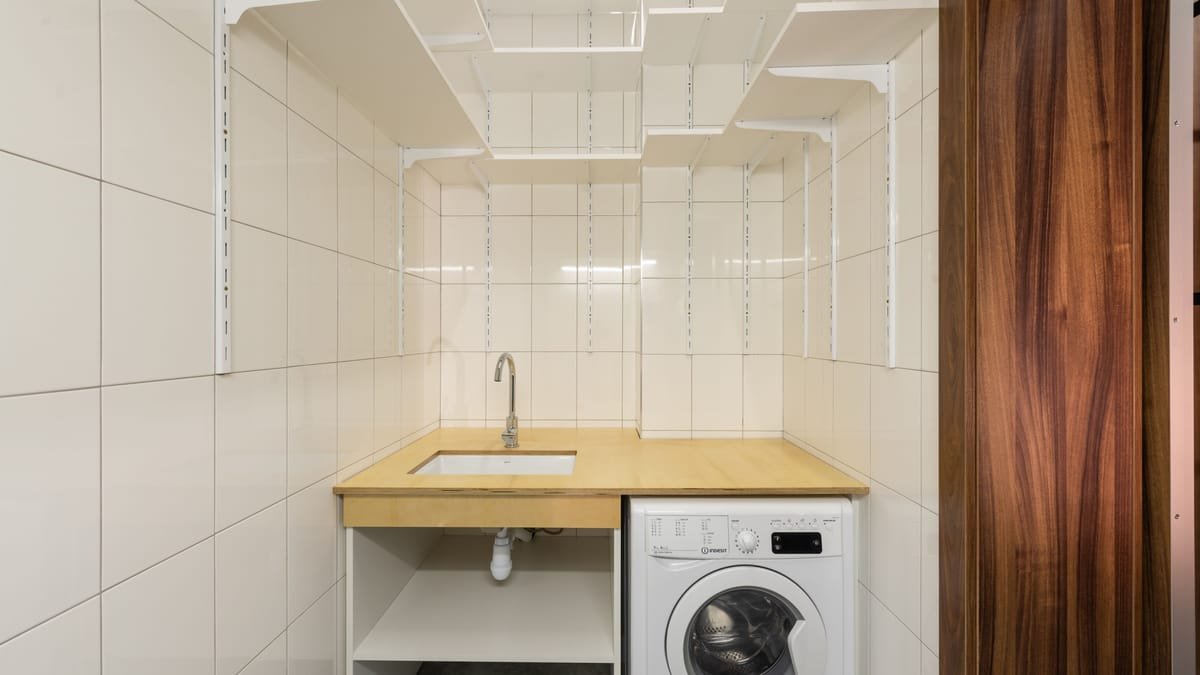
The space above the washer and dryer is the most underused in the house. A single shelf at about head height turns it into your supply zone.
- Hang one shelf first, and leave a gap. You need enough room to open a top-load lid fully, or to reach in over a front-loader, so don't set the lowest shelf too close to the machine.
- Put heavier things low and lighter things high. Bottles of detergent go on the lower shelf; backup rolls of lint bags and light baskets go up top.
- Use matching baskets with labels. A row of identical baskets looks calmer than a mix of boxes, and a label means everyone in the house puts things back in the right place.
- Choose adjustable shelf brackets if you can, like the track system in the photo above. When your supplies change, you move the shelf instead of re-drilling.
Sorting: let the baskets do the work
The most useful change in many laundry routines is moving the sorting step out of the laundry room and into the bedroom or hallway. Instead of dumping everything on the floor on laundry day and sorting from the pile, sort clothes as they come off.
- Divided hamper or two baskets: lights and darks cover most households. Add a third for "wash separately" (new dark jeans, towels, anything that bleeds).
- By person: a basket per family member works well when everyone folds and puts away their own clothes. It also solves the "who does this sock belong to" question.
- A mesh bag for delicates and small items hung on a hook in the sort zone, so bras, socks and baby clothes go in already protected.
- A tote for "take to the dry cleaner," so those pieces don't get washed by mistake.
Fold zone and hanging space
If you have a countertop, protect it. If you don't, a fold-down wall table, a board that rests on top of a front-loading washer and dryer, or a rolling cart that tucks between the machines can all work. A flat surface is the single feature that most improves a laundry room, because it lets you finish the job where you started it.
- A hanging rod (a tension rod in a nook, or a short rod on the wall) gives you somewhere to hang shirts straight out of the dryer so they don't wrinkle in the basket.
- A drying rack that folds flat against the wall or behind the door is worth having for sweaters, activewear and anything labeled "lay flat to dry."
- A small bin for "needs mending" (loose buttons, a torn hem) keeps those pieces from going back into the closet unfixed.
Small laundry rooms, closets and no-drill setups
If your laundry is a closet, a hallway nook or part of the bathroom, the same zones apply. You just compress them.
- Stacked washer and dryer: the wall space above is your supply zone. A shelf or a tall, narrow rolling cart on one side handles the rest.
- Over-the-door organizer: a pocket organizer on the back of the door holds the small stuff, such as stain sticks, dryer balls, lint brush and spare hangers, and uses space that doesn't count.
- Freestanding shelf units and rolling carts: no drilling, and they move with you. Over-the-washer units that stand on the floor and straddle the machine are the renter-friendly version of wall shelves.
- Tension rod across a nook: for hanging clothes or a row of S-hooks. Adhesive hooks hold lightweight tools but not wet laundry baskets.
- Slim gap carts (6 to 9 inches wide): check the space between the washer and the wall. Many rooms have a gap that fits one, and it holds a surprising amount of bottles.
Which laundry room layout do you have?
The same zones apply everywhere, but where you put them depends on the room.
- Washer and dryer side by side, with a counter on top: the counter is your fold zone, so keep it empty. Put the supply shelf above it and baskets underneath.
- Washer and dryer side by side, no counter: a board that rests across both machines, or a fold-down wall table, gives you a surface without a remodel.
- Stacked in a closet: go vertical. Use the door for an over-the-door organizer and the wall above for one shelf, and fold in the bedroom instead of the closet.
- In the kitchen or bathroom: keep supplies in one lidded caddy or a closed cabinet, away from food and bath products, so the laundry doesn't spread across the room.
- In a basement or garage: see the damp-space tips below, and keep everything off the floor.
- In a hallway nook: a tall, narrow rolling cart tucked beside the machines holds bottles and baskets without taking floor space.
Basements, garages and damp spaces
If the laundry is in a basement or garage, moisture and dust matter more than looks. Keep everything off the floor, since a spill or a leak from the washer will find it. Use plastic or metal shelves rather than particleboard that swells when damp, and keep fabric baskets off the bottom shelf. Closed bins protect paper goods (like the boxes of dryer sheets) from humidity. And if you ever notice a musty smell, check for hidden leaks and mildew before blaming the clothes.
The lint, stain and spare-parts kit
A few small things get lost more than any other, so give them one dedicated container: a stain stick or spray, a small scrub brush, safety pins, a lint roller, spare hangers and a pair of rubber gloves. A small caddy that you can carry to wherever the stain is works better than a drawer you have to open. Keep the lint screen clean after every load too, and read the dryer cleaning guide for the vent, which is the part that matters most for safety.
Budget ideas vs. worth splurging on
- Budget: a tension rod, adhesive hooks, matching dollar-store baskets with handwritten labels, a repurposed bookshelf for the supply zone, a cardboard box turned into a "donate" bin.
- Worth it: a divided hamper or sorting cart on wheels, adjustable wall shelving, a countertop or fold-down table for folding, a child-safe latch on the cabinet where you keep detergent, and a good drying rack.
A simple weekly laundry routine
A tidy room helps, but a routine is what keeps it tidy. Here is a plan that fits most households.
- Sort as clothes come off. Lights, darks and a "wash separately" basket, so laundry day starts with piles that are already ready.
- Pick a rhythm and stick to it. Either one load a day, or one or two bigger days a week. A steady rhythm keeps baskets from overflowing.
- Move each load through all five steps the same day. A load that ends up in a basket, unfolded, is how the folding pile starts.
- Don't leave the dryer running when you go out or to bed. The NFPA advises turning it off, and our dryer guide covers the lint and vent habits that go with it.
- Give bulky items their own day. Pillows and heavy blankets take longer to wash and dry, so plan them separately. See our guides to cleaning pillows and washing a weighted blanket.
- Put the clean clothes away before you start the next load.
The two-minute reset
The room stays organized if you reset it at the end of each laundry day. It takes two minutes:
- Empty the lint screen and wipe the top of the machines.
- Put every bottle back in its zone and close the cap.
- Move the clean clothes out of the room, even if they haven't been put away yet.
- Check the floor and the sort zone for strays.
Every few months, do a deeper pass: check expiry and condition on products, wipe the shelves, and pull anything that has migrated in from the rest of the house.
Laundry room organization checklist
- All non-laundry items are out of the room.
- Detergent, packets and bleach are in original containers, high and closed (locked if there are kids or pets).
- One shelf holds the supplies you grab every week.
- Sort baskets are in place and labeled.
- There is one clear, flat folding surface.
- There is a rod or rack for hanging and air drying.
- A small caddy holds the stain, lint and spare-parts kit.
- The floor and the space behind the machines are clear.
- The lint screen is emptied after every load.
- You have a two-minute reset on your calendar after wash day.
Sources
- HealthyChildren.org (American Academy of Pediatrics), Laundry Room and Detergent Safety
- U.S. Consumer Product Safety Commission, poison dangers with liquid laundry packets
- CDC, MMWR report on chlorine and chloramine gas from mixing cleaning products
Frequently asked questions
How do I organize a small laundry room?
Go vertical. Install shelves above the washer and dryer, hang a rod or a fold-down drying rack on the wall, and use the back of the door for an over-the-door organizer. Keep only what you use every week within reach and move the rest to a higher shelf or another room.
Where should I store laundry detergent?
In a high, locked cabinet if there are children or pets in the home, in the original container with the label on. Don't store detergent or packets on top of the washer or dryer or in drawers under the machines. Decanting dry powder into a closed bin is fine, but keep liquids and packets in their original packaging.
What is the best way to sort laundry?
Use a divided hamper or two or three separate baskets so clothes are sorted when they come off your body, not on laundry day. Lights, darks and a "wash separately" basket covers most households. Sorting by person works better for families who fold and put away their own clothes.
How can I organize a laundry room without drilling?
Use a freestanding shelf or a rolling cart between the machines, an over-the-door organizer, a tension rod across a nook for hanging clothes, and adhesive hooks for lightweight tools. Over-the-washer units that stand on the floor and straddle the machine need no wall mounting.
How often should I clean and reset the laundry room?
A two-minute reset after each wash day (empty the lint screen, wipe the machines, put stray items back) and a deeper pass every few months to clear old products, orphaned socks and anything that has migrated into the room.
What should be in a laundry room?
Only things tied to laundry: the washer and dryer, detergent and stain supplies stored safely, sort baskets, a clear folding surface, a rod or rack for hanging and air drying, and a lint brush. Cleaning supplies and household items that don't touch laundry belong somewhere else.
How do I keep a laundry room organized?
Give every item a zone, label baskets and shelves, reset the room for two minutes after each wash day, and do a deeper pass every few months to clear old products and anything that has migrated in from the rest of the house.
Is it safe to store detergent on top of the washer?
The American Academy of Pediatrics advises against it. It says to keep laundry products out of sight and reach of children and pets, ideally in a high, locked cabinet, in their original containers, and not on top of the washer and dryer or in drawers under the machines.
How should I organize laundry baskets?
Use a divided hamper or two or three baskets: lights, darks and a "wash separately" basket cover most households. Sorting by person works better when everyone folds and puts away their own clothes, and a mesh bag keeps delicates and small items together.
This site may earn a commission from products linked here, at no extra cost to you.