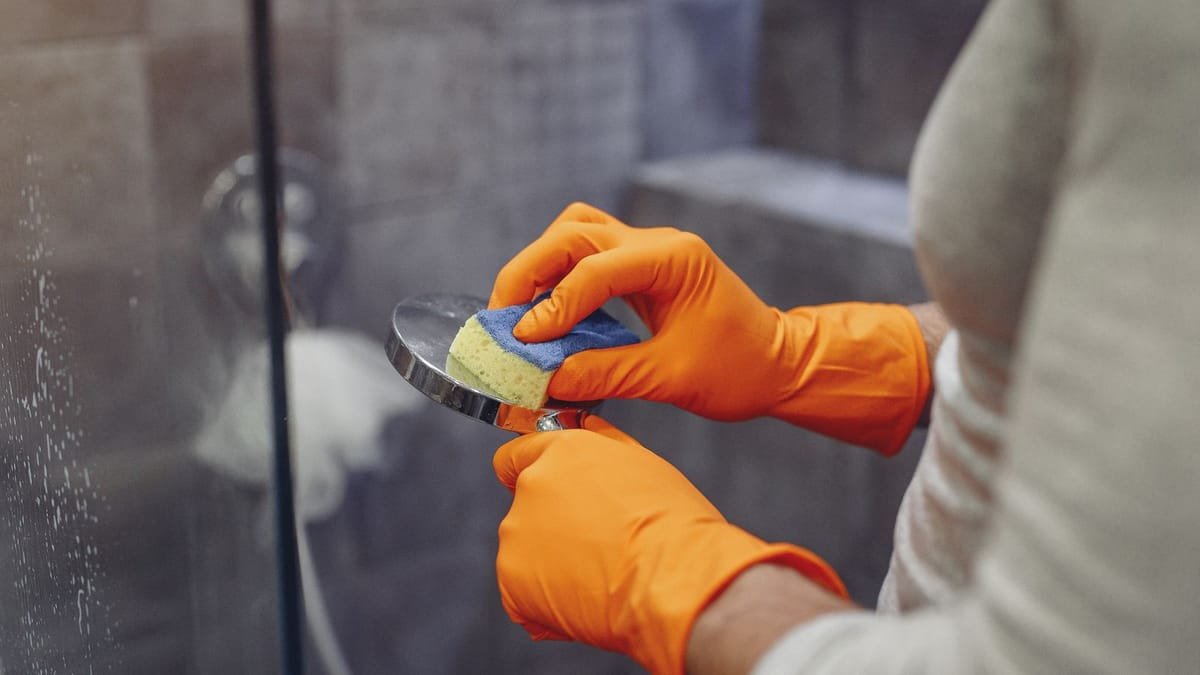
Quick answer
Pour about 12 oz of distilled white vinegar into a large re-sealable plastic bag, slide the shower head in so the nozzles are covered and secure the bag around the shower arm with a rubber band. Leave it overnight (at least an hour if you're in a hurry), then remove the bag, run hot water for 5 to 10 minutes and scrub leftover deposits with an old toothbrush. This is American Standard's no-removal method. For heavy buildup, take the head off and soak it in a bowl instead.
A shower head spends its life in hot, hard, mineral-rich water, which is exactly what leaves scale behind. Over time the little nozzles clog, the spray turns weak or uneven, and a film of buildup collects around the face. Cleaning it takes about ten minutes of work and one night of soaking. This guide walks through two methods, the finish and safety details to watch, and the schedule that keeps it from coming back.
Why a shower head needs cleaning
American Standard says shower heads collect calcium deposits, water stains and clogged nozzles over time, and that a neglected one can accumulate mildew and mold that can carry harmful bacteria. There is also a public-health angle. The Wisconsin Department of Health Services says Legionella bacteria can grow in household plumbing fixtures such as showers, and that sediment and biofilm (pipe slime) help the bacteria survive. Its action steps include regularly cleaning or replacing plumbing fixtures like shower heads, aerators and faucets to prevent mineral buildup and biofilm growth. The New Jersey Department of Health puts it simply: thoroughly clean or replace shower heads whenever buildup is visible.
You don't need to be alarmed. For most households the practical takeaway is the same as for any other part of the bathroom: clean it before it builds up, and flush it if it hasn't been used.
Signs your shower head needs cleaning
- The spray is weak, uneven or sprays off to the side
- White or chalky crust around the nozzles
- Some nozzles are completely blocked
- Water stains or a slimy film on the face of the head
- You can see buildup, which is the New Jersey Department of Health's own trigger for cleaning or replacing it
How often to clean a shower head
The guidance differs by source, so use it as a range. American Standard suggests its quick vinegar-bag method as often as once a week to keep a shower head fresh. The New Jersey Department of Health says to clean or replace it whenever buildup is visible. A practical middle ground is to look at the nozzles when you clean the rest of the shower, and soak the head as soon as you see crust or notice the spray changing. If you have hard water, buildup will show up sooner, so expect to clean it more often.
What you need
- Distilled white vinegar
- A large, sturdy re-sealable plastic bag (for the no-removal method)
- A rubber band or a sturdy twist tie
- An old toothbrush and a toothpick
- A bowl big enough to hold the head (for the removal method)
- A wrench and a small cloth, if you're removing the head
- A soft cloth to wipe the face dry
Method 1: soak it without removing it
This is the easy version, and it works for most shower heads. These steps follow American Standard's guide.
- Fill the bag. Pour about 12 oz of distilled white vinegar into a large re-sealable bag, and use more if your head is large.
- Bag the head. Slide the shower head into the bag so the nozzles are covered, then wrap the open end of the bag around the shower arm and secure it tightly with a rubber band.
- Soak. Leave it overnight. If you need it clean right away, American Standard says at least an hour.
- Remove the bag and flush. Take the bag off and run hot water through the head for 5 to 10 minutes to remove all of the vinegar.
- Scrub. Use an old toothbrush on any deposits that are left, until the face is clean.
- Rinse once more. Run the water again to wash away any remaining loosened buildup.
Check that the bag is secure before you walk away, because a bag full of vinegar that slips off will spill onto the shower floor. If the head is heavy, support the bag from below with a second rubber band or a piece of tape on the arm.
Method 2: remove it and soak it in a bowl
Use this version when the buildup is heavy or when the nozzles are badly clogged. These steps also follow American Standard's guide.
- Remove the shower head. Unscrew it from the shower arm by hand. If it's stuck, use a wrench on the nut, but wrap the nut and the arm in a small cloth first to protect the finish and avoid scratches.
- Rinse it. Run warm water over it in the sink to loosen the deposits and dirt.
- Soak it. Fill a bowl with distilled white vinegar, put the head in so the face is covered and leave it overnight.
- Scrub. Use a toothbrush on the face, and a toothpick to make sure every nozzle is open.
- Rinse. Wash the vinegar off with water.
- Reinstall it. Screw it back onto the arm, again wrapping the arm in a cloth before using the wrench so you don't mark the finish.
Handheld shower heads and hoses
For a handheld, unscrew the head from the hose and use the bowl method. Wipe the outside of the hose with a damp cloth, and look along its length for kinks or cracks while you're at it, since a bent hose also weakens the spray. Hang the head back up so water can drain out of it instead of sitting in the nozzles.
Special finishes and filters
- Check the finish first. Brass, gold, nickel and painted finishes can react differently to an overnight acid soak, so check the manufacturer's care instructions before you leave one in vinegar. If you can't find them, soak for a shorter time and rinse well.
- Never put a wrench directly on the finish. American Standard says to wrap the nut and arm in a cloth first.
- Shower heads with filters or cartridges: follow the manufacturer's instructions to clean or replace them. The New Jersey Department of Health stresses doing this for water filters and similar devices.
If the nozzles are still clogged
- Soak it a second time and scrub again, since very old scale can take two rounds.
- Work through the stubborn nozzles one at a time with a toothpick, then rinse, as American Standard advises.
- If the spray is still weak after a second soak, replace the shower head. The New Jersey Department of Health lists cleaning or replacing as the options, and a new head is inexpensive compared with a long fight with old scale.
Hard water: why it keeps coming back
Hard water carries dissolved minerals that are left behind as the water dries on the nozzles, so the crust returns faster than it does in soft-water homes. The fix is not a stronger cleaner but a shorter cycle. Soak the head when you first see white crust, and wipe the face dry after showers if you can. The same minerals also leave film on the glass and tile, which is covered in our guide to cleaning a shower.
Run the shower after you've been away
A shower that sits unused can hold still water. The New Jersey Department of Health says to let faucets and showers run for at least 3 minutes when they have been out of use for more than a week. The Wisconsin Department of Health Services lists guest bathroom showers among the places where water can stay stagnant, and advises thoroughly flushing fixtures frequently, using both the hot and the cold water if the fixture has both. If you have a guest bathroom, run the shower for a few minutes before guests arrive.
Mistakes to avoid
- Mixing vinegar with bleach. Never mix cleaning products. Bleach and an acid like vinegar release toxic chlorine gas, as the CDC has documented. Use one cleaner at a time and rinse well between them.
- Putting a wrench straight onto the finish. Always protect it with a cloth.
- Skipping the flush. Run hot water for 5 to 10 minutes after a soak so no vinegar stays in the head or the pipe.
- Using abrasive pads on the face. They scratch the finish. A toothbrush and a toothpick are enough.
- Leaving it until it is blocked. It's easier to clean light scale than a solid crust.
Keep it clean longer
- Wipe the face of the head dry after showers when you're already squeegeeing the glass.
- Look at the nozzles whenever you clean the shower, and soak the head at the first sign of crust.
- Use the same visit to check the grout and caulk. Our guides to cleaning grout and organizing the bathroom cover the rest of the room.
Sources
- American Standard, How to Clean a Shower Head
- Wisconsin Department of Health Services, Preventing Legionella in Household Water Systems
- New Jersey Department of Health, Legionnaires' Disease and household water systems
- CDC, MMWR report on chlorine and chloramine gas from mixing cleaning products
Frequently asked questions
How do you clean a shower head with vinegar?
American Standard's quick method: pour about 12 oz of distilled white vinegar into a large re-sealable plastic bag, slide the shower head in and secure the bag around the shower arm with a rubber band. Soak overnight, or at least an hour if you need it clean right away. Remove the bag, run hot water for 5 to 10 minutes to flush out the vinegar, scrub leftover deposits with an old toothbrush, and run the water once more.
How long should I soak a shower head in vinegar?
American Standard says overnight, or at least an hour if you need it clean right away. If your shower head has a special finish such as brass, gold or nickel, check the manufacturer's care instructions first and use a shorter soak.
How often should I clean my shower head?
American Standard suggests the quick vinegar-bag method as often as once a week to keep a shower head fresh. The New Jersey Department of Health says to thoroughly clean or replace shower heads whenever buildup is visible. Hard water shows buildup sooner, so clean it more often if the nozzles clog.
How do I unclog the holes in a shower head?
Soak the shower head in vinegar, then scrub the face with an old toothbrush and clear each blocked nozzle with a toothpick, as American Standard recommends. Rinse well and run the water to flush out loosened deposits. If the spray is still weak after a second soak, replace the shower head.
Is a dirty shower head bad for you?
American Standard says a neglected shower head can accumulate mildew and mold that can carry harmful bacteria. The Wisconsin Department of Health Services notes that Legionella bacteria can grow in household plumbing fixtures such as showers, and advises regularly cleaning or replacing shower heads to prevent mineral buildup and biofilm. Legionnaires' disease mainly affects people with weakened immune systems or other risk factors.
Should I run the shower after being away?
Yes. The New Jersey Department of Health says to let faucets and showers run for at least 3 minutes when they have been out of use for more than a week. The Wisconsin Department of Health Services lists guest bathroom showers among the places where water can sit still, and advises flushing hot and cold water regularly.
This site may earn a commission from products linked here, at no extra cost to you.